
Balance Training at the Highest Level
This summer, I had the opportunity to work with some of the world’s best athletes — Slovenian ski jumpers. Over six dedicated training sessions, we focused on one fundamental quality that connects all elite performance: balance and its many sub-skills.
Using slacklines and Balansa’s new foam balance board, we trained dynamic stability, muscle stabilization, fast reactions, mental focus and prolonging the flow state.
Ski jumping is a sport where millimeters and milliseconds decide outcomes, and a refined sense of balance is what holds everything together.
Why Balance Is Crucial in Ski Jumping
In ski jumping, balance skills are present in every phase of the movement: the inrun, the explosive takeoff, flight control and landing.
Athletes must constantly adjust to changing forces while maintaining perfect posture. Even the smallest imbalance can affect distance, stability, and judged form.
Good balance also means the ability to react instantly, with absolute precision, while staying relaxed and in flow.


Slackline Training: Extreme Dynamic Balance
Slackline training offers a unique form of instability that cannot be replicated by machines or rigid balance tools.
Key benefits of slackline training for athletes:
- Constant micro-instability that activates deep stabilizing muscles
- Faster neuromuscular reactions needed to stay on the line
- Improved posture and breathing control under highly dynamic conditions
- High mental focus, demanding presence and calm under pressure
Foam Board Training: Stabilizing the Inrun
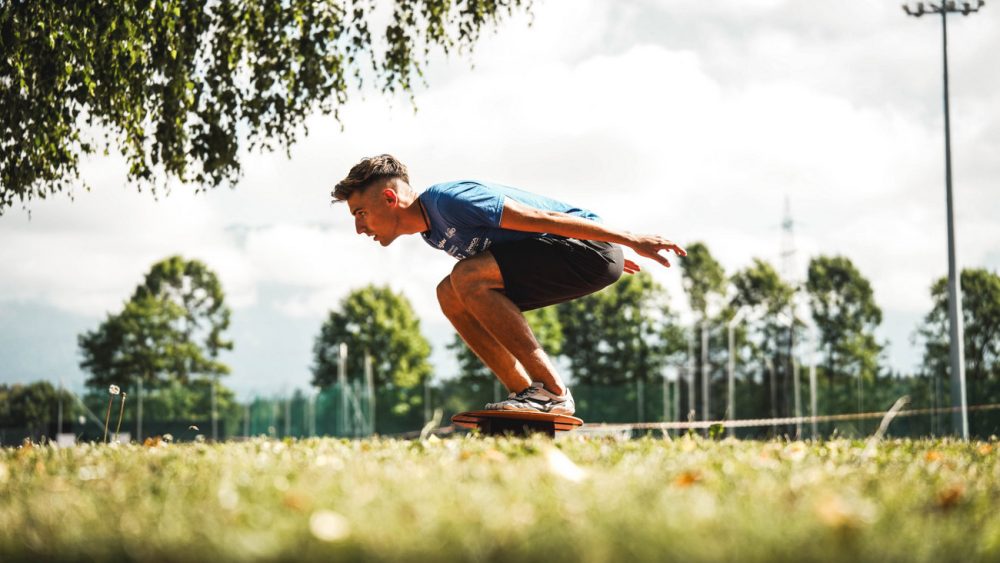
In addition to slacklines, we also used Balansa’s foam board. This new tool allowed us to expose athletes to a controlled but unstable variation of the first phase of ski jumping — the inrun.
Because the foam resists movement in all six degrees of freedom (three translations and three rotations), athletes must maintain precise body stabilization during a squat. If an athlete can stabilize efficiently on the foam board, the same movement pattern becomes easier, calmer, and more controlled during the actual jump.
How We Trained and Observed Results
We added the balance part at the end of athletes’ strength and conditioning training. That was of course more demanding since you want a strong and relaxed body for stabilizing the slackline. However, at the pro level, balancing under such difficult conditions didn’t seem as a big problem.
Majority of athletes were already familiar with slackline. All quickly gained control so we were able to perform difficult exercises, from static poses and transitions between then, to jumping and catching pine cones, all of these on a slackline of course.
We also did a waterline session, where slackline physics stay the same, but your visual reference and with it the perception of the task – change completely. I was astonished by how Domen Prevc figured it out in something like 5 minutes and almost crossed a 30m line.


Even at the highest level, the effects of 6 shorter balance trainings were noticeable. I can’t say how much better they will jump because of it, but with the help of slacklines and Balansa foam boards, we fine-tuned balance skills that are essential in any professional sport.
These are subtle changes — but at the elite level, subtle changes make big difference.
Why Balance Training Matters Beyond Elite Sport
Working with world-class ski jumpers confirms what I see every day: balance is a universal quality and can benefit anyone. Whether you are:
- a professional athlete,
- a recreational sports enthusiast,
- or someone who simply wants to move better and prevent injuries,
Balance is not a talent.
It’s a skill — and it can be trained.